Crane transport, heavy and long.
Cranes are heavy for their size, and the boom hangs past the machine. Most need more axles than a standard lowboy and an overweight permit. Counterweights and boom sections often travel on their own trucks.
24/7 Shipping Inc. is a licensed freight broker, MC 1629455. We arrange your move with vetted carriers.
- Usual trailer
- Multi-axle lowboy / RGN
- Permit?
- Almost always
- Loads by
- Driving on over the RGN front
- We need
- Make, model, counterweight, boom, jib
To quote it right
What we ask you
- Make and model, and the type: rough-terrain, crawler, carry deck, boom truck.
- Which counterweight comes off and how it travels. On many cranes it is a separate load.
- Is there a jib, boom extensions or rigging boxes? Each one is weight and deck space.
- Who removes the counterweight at pickup and reinstalls it at delivery, and is there a crane or forklift to lift it.
- Does it drive and steer? Crawlers and dead cranes load differently.
- Pickup site, delivery site, and any site rules about access or hours.
Have the manufacturer's transport drawing? Send it. It shows what comes off and in what order.
On the road
How it moves
Rough-terrain cranes
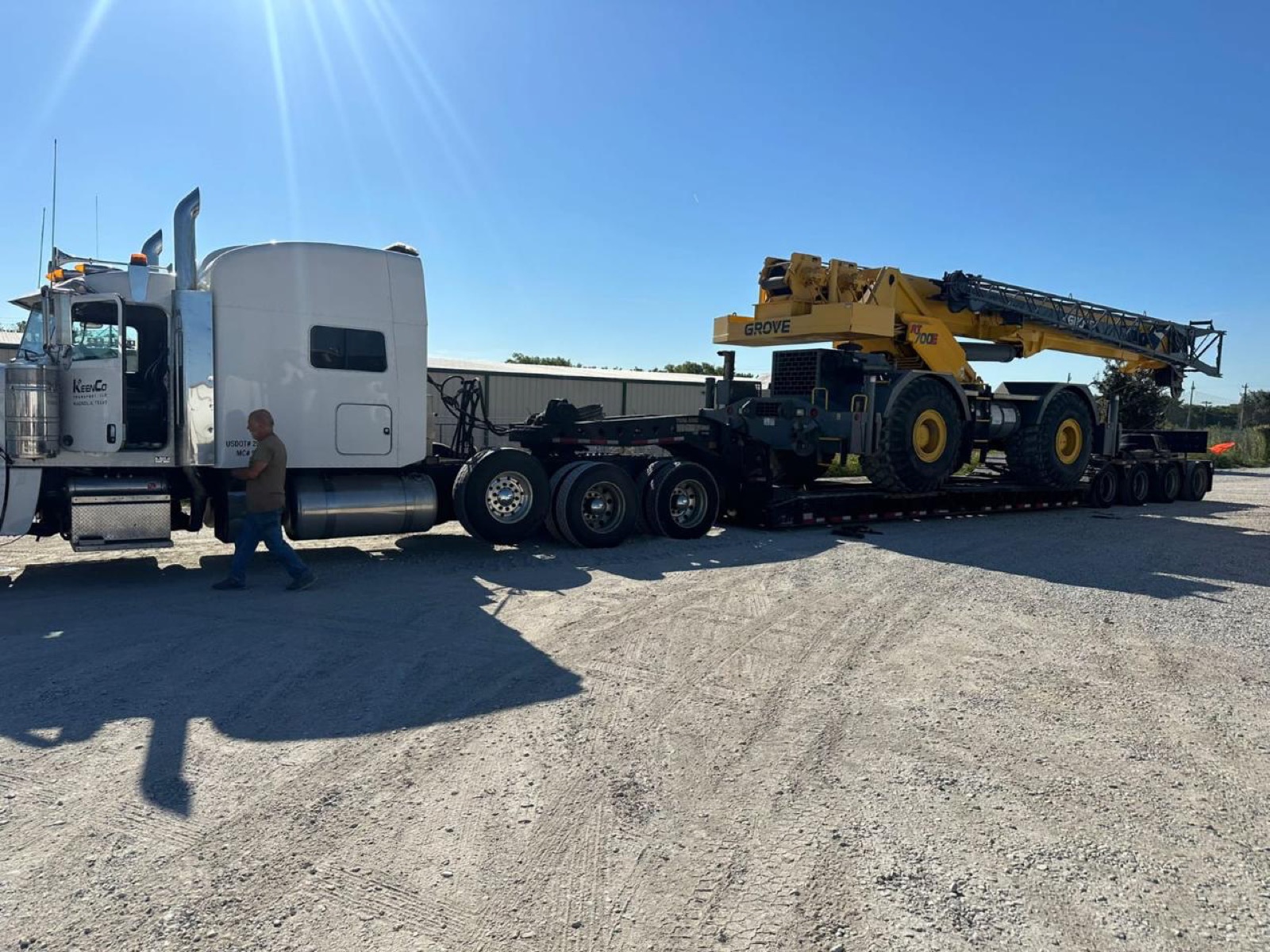
The boom is retracted and rests on a cradle or the boom rest. They usually need a lowboy with extra axles to spread the weight, plus an overweight permit, and the boom tip can stick out past the trailer.
Crawler cranes
Crawlers are taken apart for the road: base, tracks, counterweight and boom sections travel as several loads. The count of trucks depends on the crane, and the assembly crane at each end is part of the plan.
Boom trucks and carry decks
A boom truck can often drive itself if it is registered and has a driver. Carry deck cranes are small enough for a step deck or lowboy within legal limits.
Permits and escorts
Overweight and over-length permits are issued state by state and set the route, hours and escort cars. The carrier gets them; we plan the route with them before we quote.
The number
What changes the price
We quote one all-in number. These are the things that move it.
- Distance, and the empty miles to reach you.
- Weight. Extra axles and overweight permits cost more in every state crossed.
- How many loads. Counterweight and boom on their own trucks multiply the job.
- Escort cars and any route survey the states ask for.
- How flexible your dates are. Permits and escorts take time to line up.
Questions
Straight answers
How do you transport a rough-terrain crane?
It drives onto a multi-axle lowboy or RGN with the boom retracted and resting on its rest, then is chained and the boom secured. Most need an overweight permit. Some ship with the counterweight on a second truck.
Does the counterweight have to come off?
On many cranes, yes, to get under the weight a trailer and the permits allow. Someone has to remove it and lift it at both ends. Tell us early who does that.
Can a boom truck be driven instead of hauled?
Sometimes, when it is road-legal and you have a qualified driver. When it is not, it rides a lowboy like any other machine. Ask us which makes sense.
Who is responsible for the crane on the road?
The motor carrier hauling it, under its cargo insurance. We are the broker: we choose the carrier, check its authority and insurance before booking, and follow the load to delivery.
Got a machine to move?
Tell us what it is and where it is going. A person answers, asks the right questions once, and gives you one number.